What the loudness button on a vintage receiver really did
The loudness button boosted bass and treble at low volume because your ears miss both when it's quiet. Here's when it still matters.
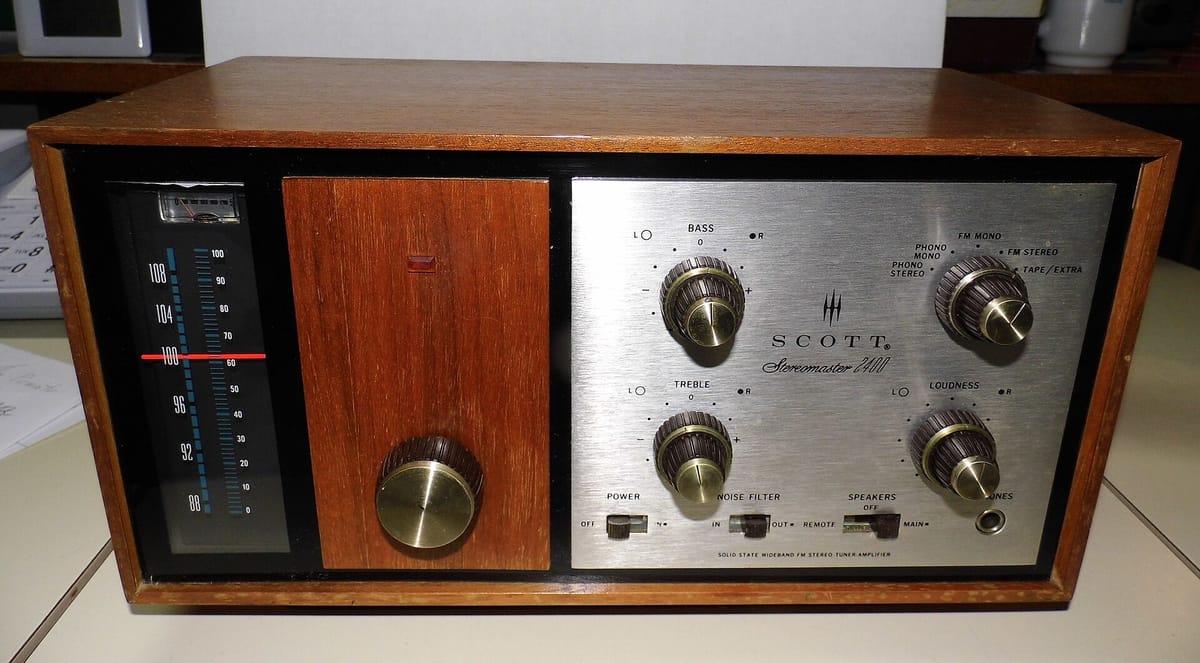
Somebody's dad kept a hand on that receiver like it was a loaded weapon. The volume knob got turned down after 10pm, and the little button marked LOUDNESS got punched in right alongside it, because that's the only way the record still sounded like something instead of a whisper coming from the next room.
Here's what it actually does: at low volume, your ears get worse at hearing bass and treble before they get worse at hearing midrange.This isn't a hi-fi marketing myth, it's basic human hearing, mapped out by researchers Harvey Fletcher and Wilden Munson at Bell Labs back in 1933 . Turn a mix down quiet enough and the kick drum and the cymbals seem to vanish first, even though they're still right there in the signal. The loudness button is a shortcut around that problem: it kicks in a bass and treble boost that only applies at low listening levels, using a tapped volume control wired to a filter network, so the music still sounds full when you're keeping it down for the people asleep down the hall.
You can hear the engineering compromise if you listen for it. Crank the volume back up with loudness still engaged and the bottom end turns to mud, boomy and bloated, because the circuit doesn't know you've stopped needing the boost.That's exactly why every stereo manual from Pioneer to Marantz to Technics printed the same quiet warning near the loudness switch: for use at low listening levels only . Nobody read the manual. Everybody pushed the button anyway, because it made the tape deck or the turntable sound bigger at three in the morning with the volume knob barely cracked.
The switch itself had a particular feel, a stiff mechanical click with a little resistance before it seated, nothing like the soft give of a tone control. You'd press it in, hear the bass swell under whatever was playing, the Styx record or the mixtape dubbed off the radio, and feel like you'd just gotten away with something. In a lot of households you basically had, since it let you keep listening after you were supposed to have the stereo off.
Is the button still useful, or is it a dead feature from a dead format war? Genuinely still useful, just narrower than it used to be. If you're running small bookshelf speakers at apartment-safe volume late at night, a loudness compensation circuit (now sometimes a DSP setting instead of a physical switch) earns its keep, because the Fletcher-Munson problem never went away just because the gear got smaller. Crank a modern system to actual listening volume, though, and loudness mode should come off, same as it should have in 1983. The physics didn't change. Only the knob did.
It's a cousin to the kind of studio-side engineering fix we got into with the noise gate accident that built the 80s drum sound, a piece of gear doing exactly what it was built for and then getting pushed somewhere nobody designed it to go.
Did your house have a loudness button, and did anyone ever actually turn it off?