Nebraska: the desert island record cut on a Teac four-track
Springsteen's Nebraska (1982), recorded alone on a Teac 144 cassette four-track, is the one album I would never trade for the full-band version.
Here is the pick: Nebraska, recorded by Bruce Springsteen alone in a rented house in Colts Neck, New Jersey, onto a Teac 144 four-track cassette recorder , and released in September 1982 with almost none of it re-recorded. The demo became the record. That is the whole argument.
You can hear the room before you hear the song. Open on My Father’s House or the title track and there is a low electrical hum sitting under the vocal, the kind of noise you get from a cheap mixer and a bedroom with hardwood floors, not a padded studio built to erase itself. The guitar has pick noise on it. The harmonica bleeds into the vocal mic. None of it got fixed, because fixing it would have meant doing the whole thing over, and the whole thing over is exactly what killed the other version.
Springsteen tracked these songs with the E Street Band in the studio, the way he had every record before it . It did not work. The band version of Atlantic City has drums under it and a bigger low end, and it turns a guy explaining his own quiet ruin into a guy fronting a rock song. The cassette version has Springsteen's voice at the absolute front of the mix with almost nothing behind it, and that emptiness is the point. Johnny 99 and State Trooper do not want company. A full band fills in the blanks these songs need left open.
So the four-track demo got mastered directly, hiss and all, and that decision is why side two still sounds the way it sounds forty-some years later. Reason to Believe closes the record on a dry acoustic strum and a vocal that sounds like it is right next to your ear, because on the original cassette it basically was.Engineers have talked for years about how close the finished album sits to that original tape, the same room tone, the same tape hiss riding under the quiet parts .
On an island you need a record that survives repetition without wearing a groove into your patience, and Nebraska gets stranger and more comfortable the longer you sit with it. Early listens, you hear bleak: murder ballads, laid-off men, a highway patrolman choosing blood over the law. By year three you start hearing craft: how Mansion on the Hill sets up the record's whole geography in under four minutes, how the sequencing moves from specific crime stories into something closer to a national mood piece by the time you reach My Father's House. The title track does the heaviest lifting early and never loses its grip; Open All Night is the one song that only really earns its place once you know the rest of the record's quiet well enough to want a little gas-station neon and bad AM radio breaking it up.
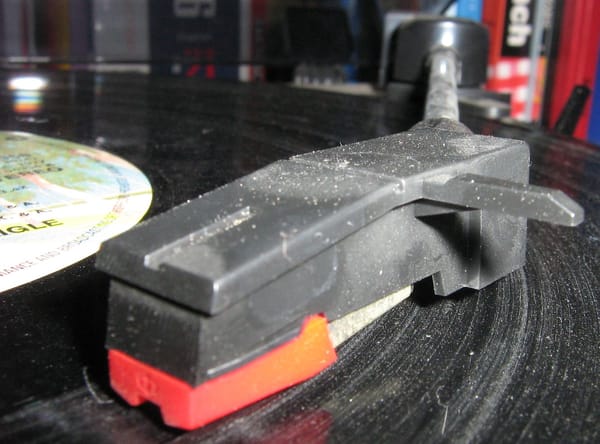
Collectors care about the pressing because the mix is so sparse that tape hiss becomes part of the material.Early US pressings on Columbia carry a noticeably different noise floor than later CD remasters that scrubbed some of the hiss down; purists want the version where you can hear the room. If you grew up dubbing records to cassette for the car, there is a strange symmetry here: Nebraska started life on cassette, got pressed to vinyl, and plenty of us then dubbed that vinyl back to cassette for the Walkman, hiss generation stacked on hiss generation, the way we once judged a transfer the way we judged a bias switch setting on a blank tape.
What makes it an island record and not just a good one is that it asks nothing of you production-wise and everything of you emotionally. There is no low end to chase on a bad system, no arrangement choice to admire, just a guy, a guitar, a harmonica rack, and a cassette deck with its gain riding a little hot. Play it on a cheap boombox or a serious hi-fi and it sounds basically the same, because it was never built to flatter equipment. It was built to flatter nothing.
What's yours?