How to tell a real vintage band tee from a reprint
A flea market guide to real vintage band shirts: single stitch hems, era-correct tags, honest print cracks, and the 2005 reprints built to fool you.
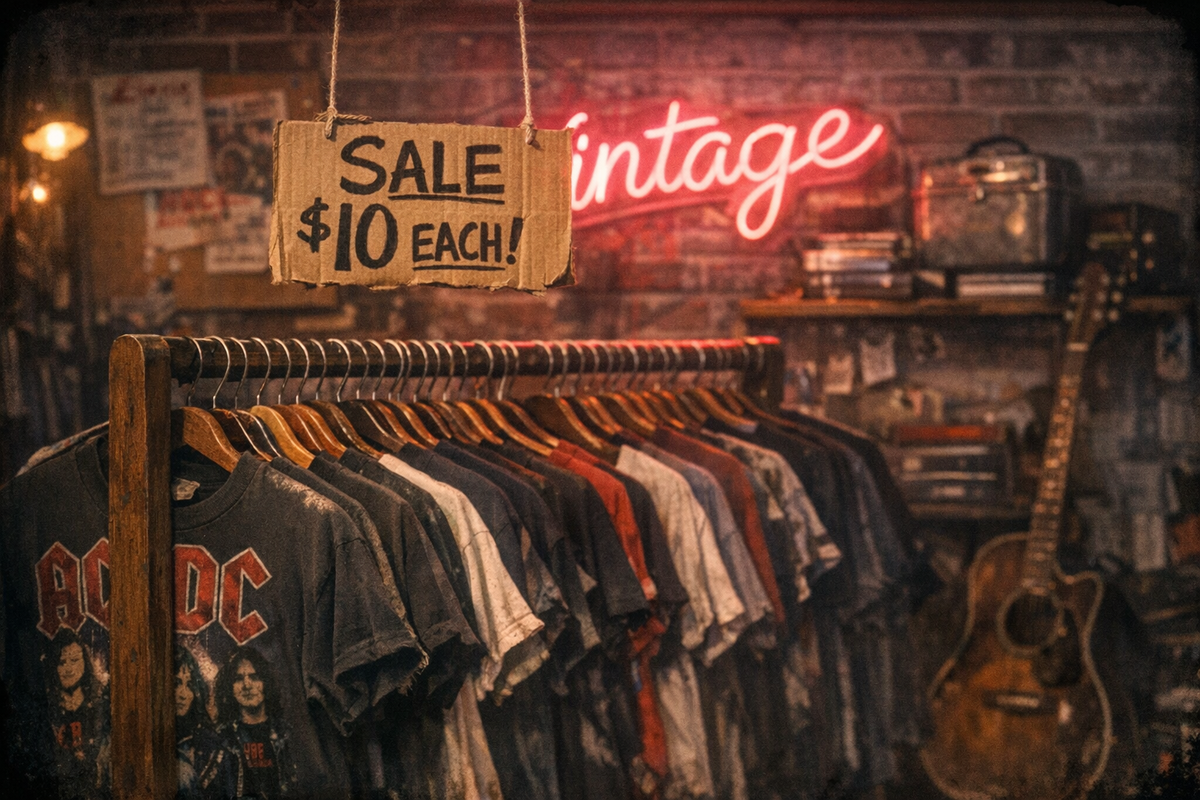
Somebody's always got a folding table of band shirts at the flea market, and somebody's always holding one up to the light like it's a Rembrandt. Here's the short answer: flip the hem inside out and look at the stitching, check the tag against what the brand actually used in that decade, and look hard at how the print cracks. A real vintage tee tells on itself in about thirty seconds if you know where to look.
Start at the hem. Before the mid-90s, most tee manufacturers finished the sleeve and bottom hem with a single line of stitching, one needle pass, visible as one row of thread when you turn the shirt inside out.Sometime in the mid-to-late 90s, factories moved to double-needle, double-stitch hems because it held up better in commercial washing and shipped cheaper at scale. So a true single stitch hem is a decent clock, not a guarantee. It tells you the shirt is probably old. It doesn't tell you it's authentic, because a close-cut, hand-finished reprint can fake a single stitch if someone's patient enough.
The tag does more honest work. Look for Screen Stars, Hanes Beefy-T, or Fruit of the Loom tags from the era, and pay attention to the actual typography and the RN number printed on them, not just the brand name.A real 80s or early 90s tag feels thin and almost papery against your thumb, often a single layer sewn flat, not the folded woven tag you see on current retail blanks. If the tag looks crisp and the fabric looks worn, something doesn't match, and mismatch is the whole game here.
Now the print. Original band tee prints from this era are almost always plastisol ink, which sits on top of the fabric rather than soaking into it, and plastisol cracks in a specific way: fine, branching lines that follow the stress points of the design, heavier where the shirt folds at the chest and underarms, barely touched where the fabric never flexes. It looks like dry creek bed, not like someone took sandpaper to the whole thing evenly. That's the tell against fakes, because artificial aging usually distresses the print uniformly across the whole chest, since whoever did it worked the entire surface instead of just the fold lines a body actually makes over twenty years of wear.
This is where the 2005 reprint boom gets people. Once vintage band tees started selling for real money, companies went back and reissued classic tour graphics on blanks cut to look period-correct, some even stitched with single-needle hems and stamped with tag designs lifted straight from originals.The ink on these is often a dead match for the original art because they're printing from the same vector files or scanned originals. What they can't fake as well is twenty years of actual handling: the slight yellowing at the collar from body oil and detergent, the drape of cotton that's gone through hundreds of wash cycles and lost its stiffness, the way a 1984 shirt smells faintly of someone's closet even after a wash, that thrift-store mix of old cotton and cedar you can't manufacture with a chemical rinse.
Hold the shirt up and check the weight too. A genuine Hanes Beefy-T from the 80s runs heavier cotton than most of what's on a blank rack today, and a reprint on a 2005-era blank often feels noticeably lighter and softer right out of the gate, because nobody's wearing modern cotton blends into submission the way a cheap heavyweight tee got worn in before 1995. None of this is forensic science. It's pattern recognition built from handling enough real ones and enough fakes that your hands start doing the thinking before your brain catches up.
If you want the deeper cut on reading a shirt's whole story instead of just its date, we've gone over the band shirt poser test before, and the same instinct applies here: the shirt should have a story that checks out under scrutiny. So next time you're at a table full of faded cotton, what's the oldest shirt you've actually found, and did the tag back it up?