The Walkman that shipped with two headphone jacks
The TPS-L2 had two headphone jacks for sharing tapes, nobody used the second one, and Sony quietly killed it by 1981.
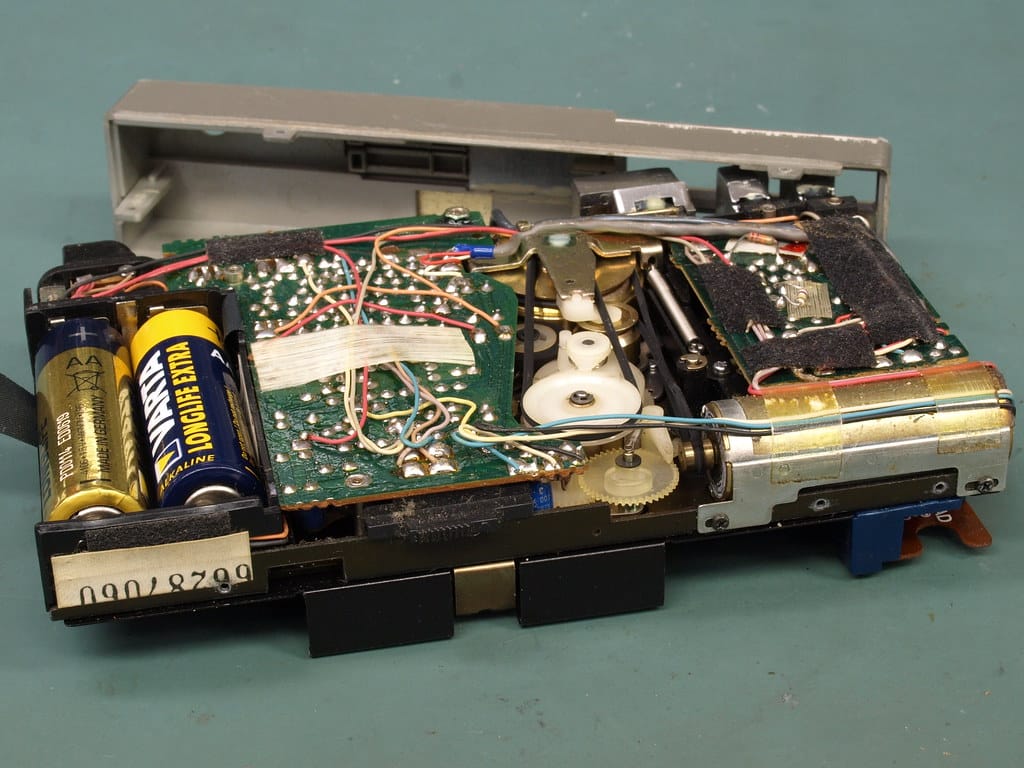
Pick up a TPS-L2 and the first thing you notice is the weight. It's a brick with a hinge, blue-gray steel and a lid that pops open with a spring-loaded snap you feel in your fingertips before you hear it. This is not a device that wants to disappear into your pocket. This is a device that wants you to know you're carrying something.
Sony launched it in Japan in July 1979 , and the pitch wasn't solitude. It was the opposite. Two headphone jacks, side by side on the right edge, because the idea was you'd sit on a bench with somebody and split the sound between two sets of foam-cushioned cans. There was even a button for it: press Hot Line and a small microphone inside would duck the tape audio so the two of you could talk without pulling the headphones off.
Look at that lineup on the top edge and you get the whole design philosophy in four colors. Orange for play, and it's a real mechanical thunk, not a soft click, the kind of tactile feedback you can't get out of a touchscreen fifty years from now. Blue for the Hot Line button. Metal switches for tone and for the mic mix, because someone at Sony still thought you might want to adjust for outdoor wind noise while sharing a tape with a friend.
Nobody used the second jack. That's the part that gets left out of the legend.You bought a TPS-L2, or begged for one, or saved up your paper-route money , and the first thing you did was claim it. The whole appeal of hearing Boston or the Cars at full volume while walking somewhere was that nobody else was hearing it with you. Sharing meant somebody's cheap orange foam earpad pressed against your ear, and those pads degraded fast anyway, crumbling into little pills of foam dust after a summer of sweat and bike rides.
By the time the TPS-L2 got to American shelves under the Walkman name in 1980 , Sony had already clocked what people actually wanted.The second generation, the WM-2 in 1981 , dropped the second jack entirely. Gone too was the Hot Line mic-mix feature, the tone switch simplified, the whole chassis shrunk down until it was closer to the size of the cassette case itself. That's the real story of Walkman miniaturization: it wasn't just better engineering, it was Sony cutting the features nobody used to chase the size everybody wanted.
The WM-2 is the one people picture when they say Walkman, thin enough to fit a jacket pocket, light enough that you forgot it was clipped to your waistband until the tape ran out mid-song and you had to flip it manually because auto-reverse wasn't standard yet either. Compare it side by side with a TPS-L2 and the TPS-L2 looks like a prototype from a different decade, even though only two years separate them. In tech-hardware time, that's a generation and a half.
What survives from the original besides the orange and blue buttons is the sound of that lid. Open a TPS-L2 today, if you're lucky enough to own one or have handled a friend's collection, and the cassette door still has resistance, still needs a real push to seat the tape, still gives you that satisfying clunk when it locks. Compare that to inserting a cassette into a dashboard deck: same tactile grammar, same mechanical honesty, no plastic-flex mush.
The foam earpads are long gone on most surviving units, disintegrated into orange crumbs that stain a velvet-lined display case if you're not careful. Collectors replace them with foreign reproduction pads that never quite match the original density, a little too springy, a little too clean-smelling compared to the vinyl-and-foam funk of the real thing after a summer of use.
Try to find an unmolested pair of original pads on a working TPS-L2 in 2026 and you're paying real money for a feature nobody ever used, on a machine everybody wanted anyway.
Next week: the tape-to-tape dubbing deck and the format war nobody won on purpose.