The boombox trick that built Stop Making Sense
Byrne walks out alone with a boombox and Psycho Killer, then the band assembles onstage song by song, Demme's camera watching it happen.
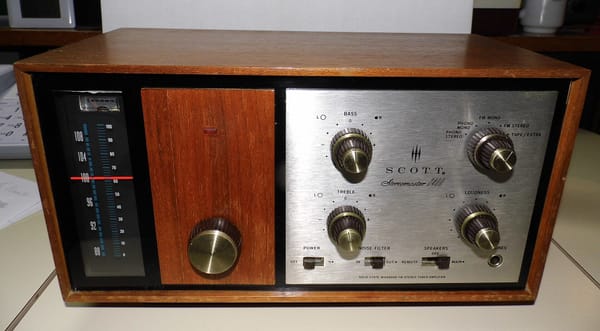
The house lights haven’t even fully dropped and David Byrne is already walking out alone, sneakers on a bare stage, carrying a boombox in one hand and an acoustic guitar in the other. He sets the boombox down. He presses play. A drum machine clicks out the beat and he starts into “Psycho Killer” with nobody behind him, no band, no rig, no lights built yet, just a rehearsal-room silhouette against a plain backdrop. If you’d never seen the film before, that opening tells you something is wrong with your expectations, and it’s supposed to.
Every concert film you’d seen up to 1984 opened the same way: full band, full volume, wide shot of the whole stage lit up like a runway. Stop Making Sense refuses that grammar completely.Tina Weymouth walks out for the second song, “Heaven” , and it’s just the two of them. Chris Frantz joins on drums after that. Jerry Harrison after that.By the time the extended lineup fills in, Bernie Worrell on keys, Alex Weir on guitar, Steve Scales on percussion, Lynn Mabry and Ednah Holt on backing vocals , you’ve watched an entire band get built in front of you in real time, plank by plank, like a stage crew is assembling it during the show instead of before doors.
That structure was Jonathan Demme’s call, not a budget shortfall the band papered over with a clever edit.Demme had cut his teeth on Melvin and Howard and Citizens Band, and he came into this project treating the Talking Heads’ 1983 touring show, already staged with this exact build-up concept by Byrne, as a piece of dramatic architecture rather than a set list to point cameras at . He reportedly refused the standard tools of the genre: no audience reaction cutaways for most of the run time, no backstage interviews, no manager talking about how special this tour is. Just the stage, filling up.
The film was shot over four nights at the Pantages Theatre in Hollywood in December 1983 , and the crew rigged it so cameras could move on tracks without walking through sightlines the way a typical multi-cam concert shoot would. That’s why the wide shots feel so patient. You get to watch Frantz settle onto his stool, watch cables get walked across the stage floor by hand, watch the lighting rig itself grow more complex as more bodies need covering. It’s staging as narrative, and the camera trusts it enough to just sit there and let it happen instead of cutting away every four seconds the way most concert films panic into doing.
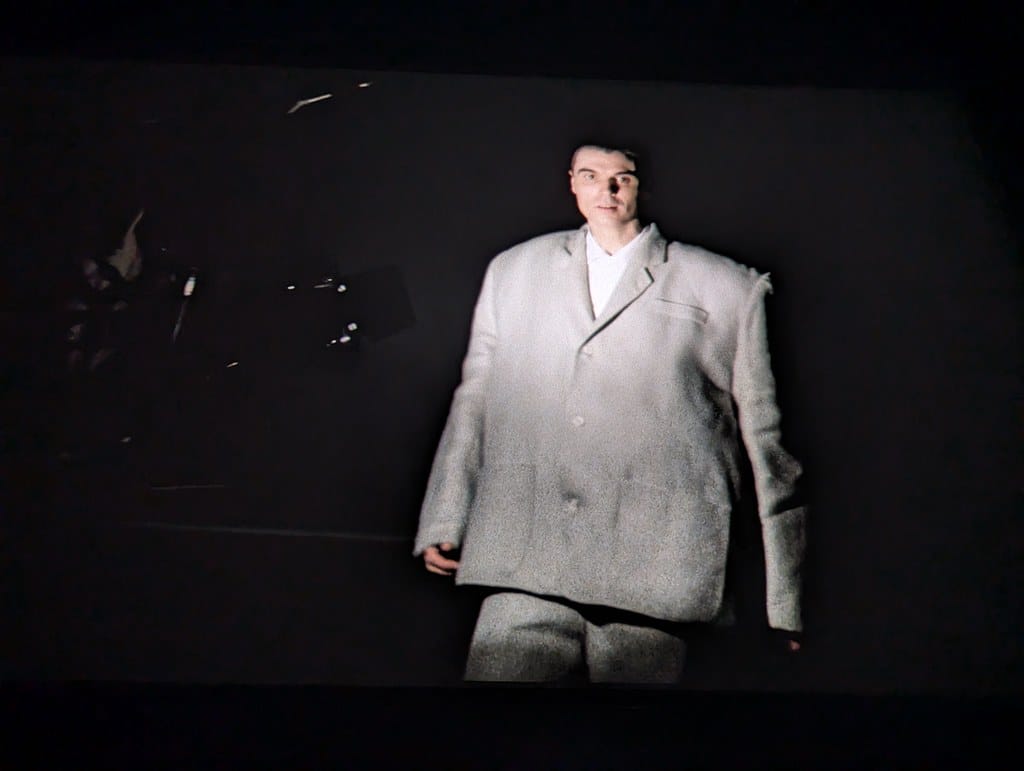
By “Girlfriend Is Better,” Byrne comes out in the big suit, the boxy oversized jacket that turns his head into a small dot on top of a huge gray rectangle, and by then the stage is so full of musicians and gear that the suit reads as another structural joke: the show has built itself out from nothing into something almost too big for the frame . You don’t get that joke if you didn’t sit through the boombox. The whole film is a lesson in delayed gratification that nobody in 1984 concert-film distribution thought an audience would sit still for.
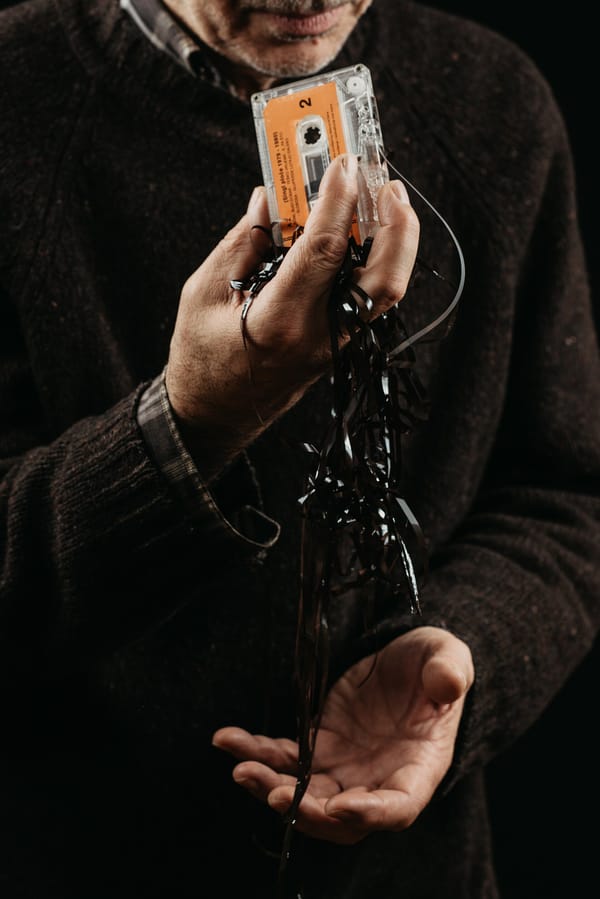
Watch it now on a decent set of speakers and the drum machine hiss under Byrne’s solo intro still does something a fully mixed band mix never could. It’s thin, a little cold, almost demo-tape rough, the exact texture of a cassette you dubbed off a friend’s copy because the video store never had it in stock. That rawness is the whole point: the band hasn’t arrived yet, and neither has the sound.
Most concert films are a record of a night. This one is a record of a building getting built. Have you ever sat through the whole thing start to finish without skipping ahead to the big suit?