Daydream Nation: the double LP that earns the walk
Sonic Youth's 1988 double LP makes you get up four times a side, and that's exactly why it never wears out.
Daydream Nation is the one. Not because it's the loudest thing Sonic Youth ever made or the most accessible, but because a double LP that forces you off the couch four separate times a listen is a record that demands you stay a participant instead of a passenger.
You cannot let this album happen to you. Side one ends with “Teen Age Riot” still ringing and you have to get up, flip, and drop the needle on “Silver Rocket” before the mood breaks. That physical interruption, that small chore, is the whole argument for why the format matters here. A streaming playlist smooths this record into background noise. Vinyl makes you clock in four times.
The sequencing is the real production choice, more than any pedal or tuning.Side one is the side that gets you: “Teen Age Riot” opens with that long clean guitar wash before Thurston Moore's vocal even shows up , a bait-and-switch that tells you this is a pop record wearing a noise record's clothes. Side two turns colder and more fractured, “Kissing the Beard”... no, actually “The Sprawl” and “Cross the Breeze” do the heavy lifting, Kim Gordon's vocal sitting low in the mix like she's talking to herself in another room. Side three is where the record earns its reputation, “Hey Joni” and “Providence” and the queasy detour of “Candle,” proof that Lee Ranaldo's songs aren't filler, they're the tension valve. Side four is the marathon, “Trilogy” unspooling across three parts that only make sense once you've sat with the whole album a dozen times.
Here's what holds up on listen 500: the guitar interplay.Moore and Ranaldo tuned their guitars to open, non-standard configurations for nearly every song , which means the chords ring in ways your ear can't quite parse even after years of familiarity. That's the trick. A record built on standard tuning gives up its secrets by listen fifty. This one still has a corner you haven't checked.
What only earns its place in year three is “Providence,” the answering-machine interlude with Mike Watt's voicemail bleeding into a piano drone . The first hundred times through, you reach for the next track. Eventually you understand it's the record exhaling, and skipping it is like skipping the quiet bar before a chorus hits.
Pressing notes, because this is where the arguing happens.The original 1988 release came out on Enigma Records as a gatefold double LP , and that pressing has a warmer, slightly murkier low end that some collectors swear is the true mix.The 1995 reissue moved to DGC/Geffen after the band's major label jump , remastered and noticeably brighter in the top end, which some longtime owners still resent.Then there's the 2007 deluxe reissue on Geffen with bonus live tracks and a remaster overseen by the band , a nice listen but not the object you want if you care about matrix runouts. Hunt the Enigma pressing if you can find one with the dead wax etching intact; the run was smaller and the covers show real handling wear now, corner dings and split spines from being hauled to a hundred dorm rooms.
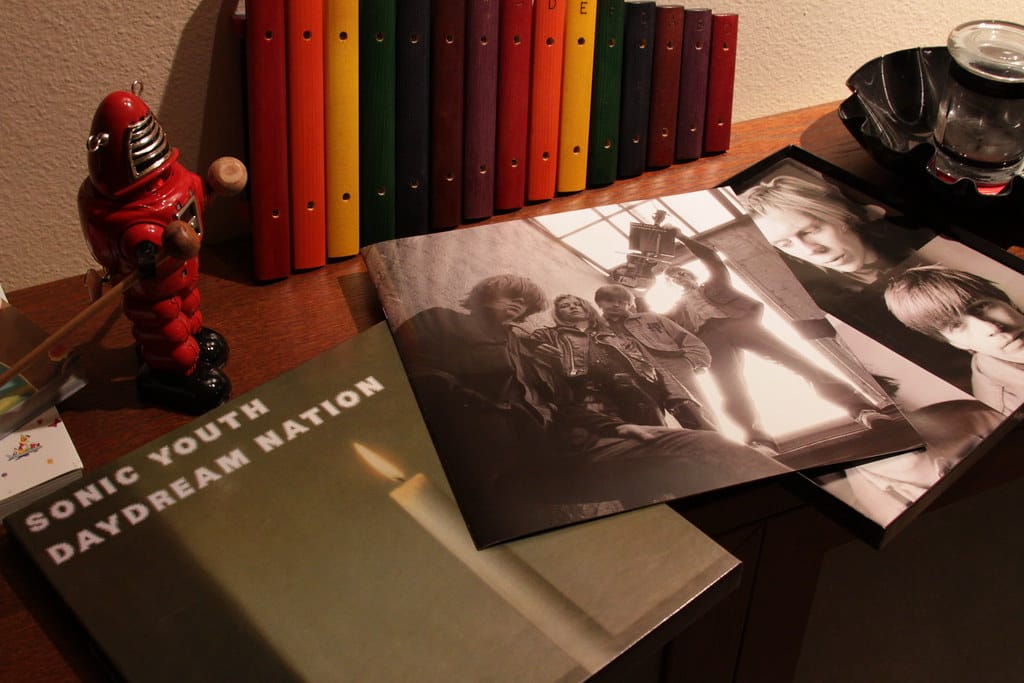
The gatefold itself is part of the case. Gerhard Richter's candle painting on the cover doesn't shout at you from a record store bin, it just sits there looking like a still life until you know what's inside, and then it looks like a warning. Crack the gatefold open and the smell of thirty-plus-year-old cardboard and old glue is its own kind of proof of life, evidence that this thing has been opened and closed a few thousand times by people who felt the same way you do.
An island only gives you one album, which means no shuffling, no skipping to the “hits.” Daydream Nation survives that sentence because it was built to be walked through start to finish, interruptions included. The four-sided structure that seems like a hassle on a rainy Tuesday is exactly what keeps the record from ever going stale: you can't zone out on something that keeps asking you to stand up.
What's yours?